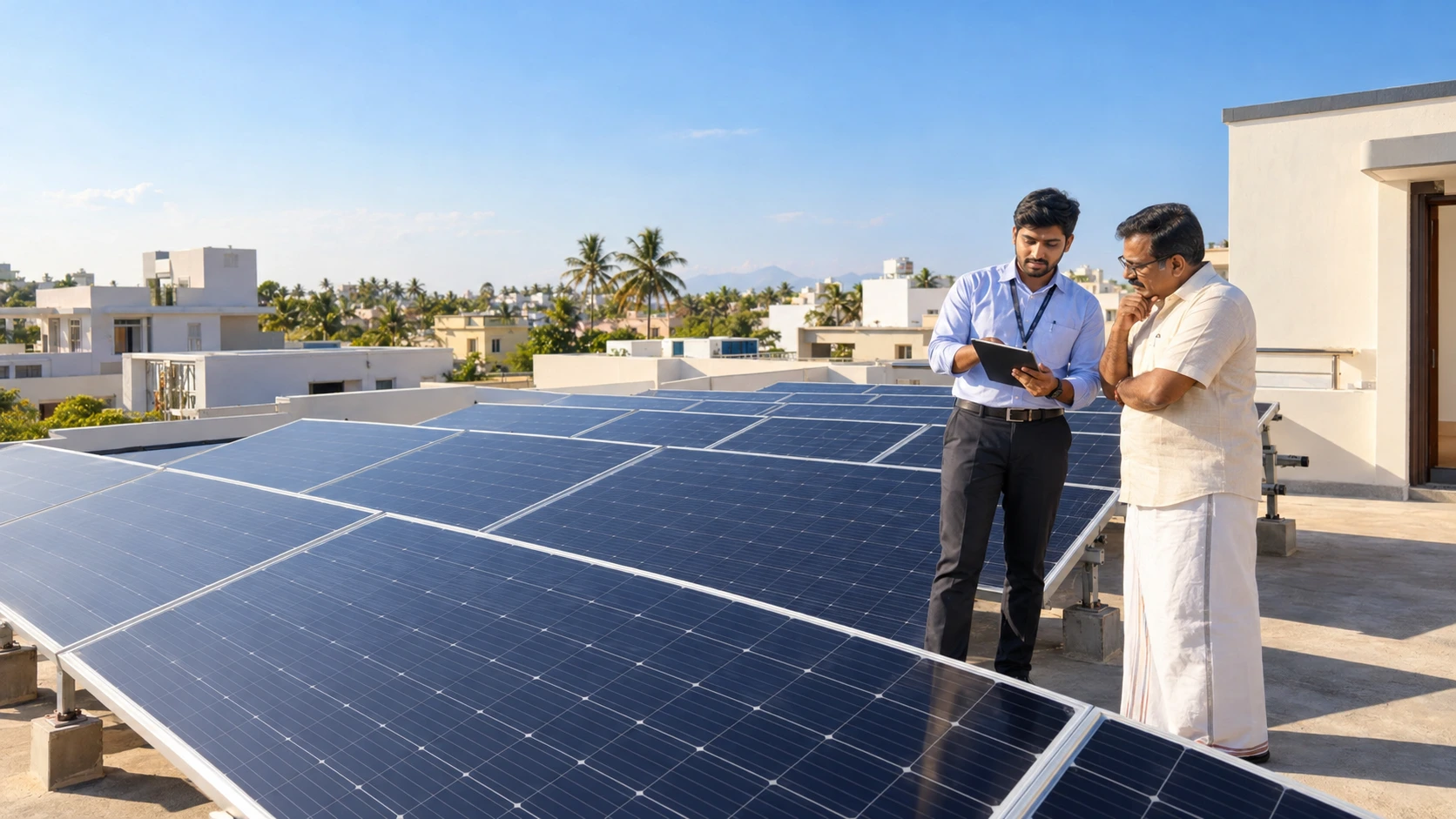
How to Choose Solar Panels That Last: 7 Things to Check Before Buying
Choosing solar panels involves more than comparing prices and wattage. Learn how to evaluate solar panel efficiency, warranties, durability, heat performance, certifications, and installation quality before investing in a rooftop solar system.
Choosing solar panels for your home is an important decision. A rooftop solar system can serve your household for many years, so the panels you select today can influence how much electricity your system generates in the future.
When comparing solar panels, many homeowners focus mainly on price and wattage. While these factors matter, they do not tell the whole story. Panel efficiency, temperature performance, warranty coverage, manufacturing quality, and installation standards also deserve attention.
This is particularly important in Tamil Nadu, where rooftop solar panels are exposed to strong sunlight, high temperatures, seasonal rainfall, dust, and changing weather conditions.
So, how do you choose solar panels that offer reliable performance over the long term?
In this guide, we explain seven important things to check before buying solar panels for your home or business.
Why Does Solar Panel Quality Matter?
Solar panels are designed to generate electricity for decades, but their actual performance depends on several factors, including manufacturing quality, environmental conditions, system design, and maintenance.
Two panels with similar rated capacities may differ in efficiency, temperature response, warranty terms, and expected long-term performance.
Choosing a suitable panel can help you make better use of your available rooftop space and understand what to expect from your solar investment.
Instead of asking only, "Which solar panel is cheapest?", consider a more useful question: "Which panel offers the right balance of performance, reliability, warranty, and overall cost for my requirements?"
1. Check Solar Panel Efficiency
Solar panel efficiency describes how effectively a panel converts the sunlight it receives into electricity under specified test conditions.
For homeowners with limited rooftop space, efficiency is particularly important. A more efficient panel can generally produce more power from the same surface area, assuming comparable operating conditions and suitable system design.
For example, if your roof has limited space because of water tanks, staircases, or nearby buildings, higher-efficiency panels may help you achieve your required system capacity without using as much roof area.
However, efficiency should not be the only factor in your decision. A panel with a higher efficiency rating is not automatically the best choice for every property.
Compare the actual wattage, physical dimensions, product specifications, warranty, and price alongside the efficiency rating.
What Efficiency Rating Should You Look For?
Modern residential solar panels are available across a range of efficiency levels, with many current models offering efficiencies in the low-to-mid 20% range. The exact figure depends on the model and technology.
Check the manufacturer's official datasheet instead of relying on general advertising claims. Compare panels of similar wattage and size to understand which option makes better use of your available roof area.
2. Understand the Difference Between Product and Performance Warranties
A solar panel warranty explains the manufacturer's commitments if a product develops a covered problem or its power output falls below the specified performance level.
However, not all warranties cover the same things. Understanding the difference between product warranty and performance warranty can help you make a more informed purchase.
Product Warranty
A product warranty generally covers specified manufacturing defects and material-related problems, subject to the manufacturer's terms and exclusions.
Depending on the warranty, this may include certain defects affecting the panel's construction or components. Read the actual warranty document to understand what is covered, how claims are handled, and whether labour or transportation costs are included.
Performance Warranty
A performance warranty generally describes the minimum power output a manufacturer guarantees over a specified period, according to the warranty terms.
Solar panels gradually lose some of their original power-generating capability over time. This process is known as degradation. A performance warranty sets out the manufacturer's commitment regarding the panel's remaining output at particular points during its service life.
Before buying, check the warranty duration, the stated degradation limits, the claim procedure, and the conditions that may affect coverage.
| Feature | Product Warranty | Performance Warranty |
|---|---|---|
| Main purpose | Covers specified product defects | Guarantees specified power output over time |
| What to check | Covered defects and exclusions | Guaranteed output and degradation terms |
| Claim requirements | Proof of purchase and defect assessment, as applicable | Output evidence and assessment under warranty terms |
| Why it matters | Helps protect against covered manufacturing problems | Clarifies the manufacturer's long-term output commitment |
Do not compare panels using warranty duration alone. Two manufacturers may offer similar warranty periods but different coverage conditions. Read the full terms before making your decision.
3. Evaluate Panel Performance in High Temperatures
Tamil Nadu receives strong sunlight for much of the year, making solar energy an attractive option for residential and commercial properties. However, strong sunlight also means that rooftop panels can become significantly hotter than the surrounding air.
Solar panel output is affected by temperature. Many conventional panels produce less power as their cell temperature rises above the reference temperature used for their rated specifications.
This is why checking a panel's temperature coefficient is useful when comparing models.
What Is the Temperature Coefficient?
The temperature coefficient of maximum power indicates how a panel's power output changes with temperature above the specified reference point. It is usually expressed as a percentage change per degree Celsius.
For example, consider two hypothetical panels:
| Panel Specification | Panel A | Panel B |
|---|---|---|
| Rated power | 550 W | 550 W |
| Temperature coefficient of maximum power | -0.35%/°C | -0.29%/°C |
| Output response to rising temperature | Greater percentage reduction | Smaller percentage reduction |
In this hypothetical comparison, Panel B has a less negative temperature coefficient, meaning its power output is expected to decline less for each degree of temperature increase above the reference point, all else being equal.
These figures are examples, not specifications for particular products. Always compare the actual datasheets of the panels you are considering.
Also ask your installer about ventilation beneath the panels, mounting arrangements, roof conditions, and expected operating temperatures. Good system design matters alongside panel selection.
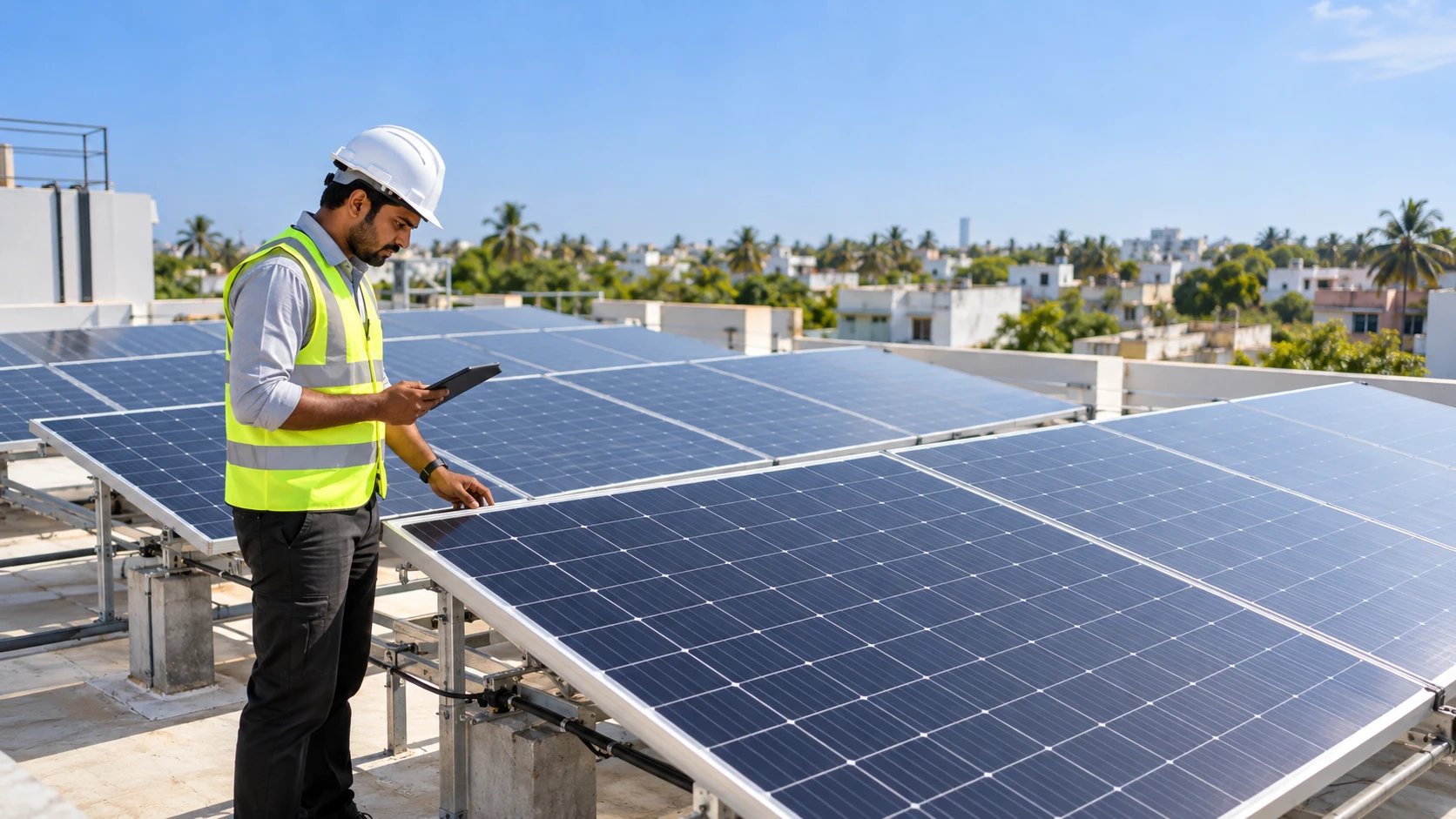
4. Check the Solar Panel Technology and Construction
Solar panels use different cell technologies and construction methods. Understanding the options can help you compare products based on your budget, roof space, and performance requirements.
Monocrystalline silicon panels are widely used in residential rooftop installations. Within this category, manufacturers offer different cell designs and technologies, each with its own specifications.
Rather than choosing a panel based only on a technology label, examine the manufacturer's datasheet and warranty documentation.
What Should You Check?
- The exact panel model and rated power output
- Cell technology and module efficiency
- The manufacturer's stated mechanical load ratings
- Resistance to environmental exposure under the specified test conditions
- The temperature coefficient and degradation specifications
- The applicable product and performance warranties
- Whether the panel meets the requirements for your intended installation
You may also encounter terms such as TOPCon, PERC, and heterojunction in solar panel advertisements. These refer to different cell technologies or architectures.
Each technology has its own performance characteristics and product options. Compare specific panel models rather than assuming that a technology name alone guarantees superior quality.
5. Verify Certifications and Scheme Compliance
Before purchasing solar panels, verify that the proposed equipment meets the relevant technical standards and any requirements that apply to your installation.
Certifications and compliance documents provide useful information about whether a product has been assessed against specified standards. However, the exact certification requirements depend on the product, installation type, and applicable regulations.
If you are planning to install a residential rooftop solar system under a government subsidy scheme in India, this check becomes especially important.
What About ALMM and DCR Requirements?
ALMM stands for Approved List of Models and Manufacturers. Domestic Content Requirement, or DCR, refers to applicable requirements concerning domestically manufactured solar cells and modules under relevant schemes.
Eligible subsidy-supported installations must comply with the rules applicable to the project, including relevant module-listing and domestic-content conditions.
Ask your installer to identify the exact panel model being supplied and explain how it meets the applicable requirements. Where relevant, verify the model and manufacturer through the official government resources.
Never assume that every panel sold in the market automatically qualifies for a subsidy-supported installation.
6. Look Beyond the Initial Price
Price is an important part of choosing solar panels, but the cheapest option is not always the best value for your home.
When comparing quotations, consider the complete system rather than evaluating panels in isolation. Your total investment may include the panels, inverter, mounting structure, wiring, electrical protection, installation labour, and other site-specific work.
The price may also differ because of equipment specifications, installation complexity, warranty coverage, and the service offered by the installer.
A useful comparison should consider what you receive for the amount you pay.
Compare the Cost Per Watt Carefully
Cost per watt is a simple way to compare prices when looking at solar equipment or installations with similar specifications and scope.
For example, if two quotations offer different system capacities, dividing the relevant price by the rated capacity can help you understand their relative cost per watt.
However, this figure does not measure quality, reliability, or the amount of electricity your system will generate. A meaningful comparison should also account for equipment, installation work, warranty terms, and expected system performance.
Think About Long-Term Value
A solar system's long-term value depends on how well it matches your electricity needs and how it performs over time.
Ask the installer for a realistic estimate of annual electricity generation based on your roof, location, shading, and proposed system size. Understand the assumptions behind the estimate and how maintenance or equipment replacement could affect your costs.
Avoid choosing a panel solely because someone promises a guaranteed savings figure or a fixed payback period. Actual results depend on your consumption, electricity tariff, system performance, and applicable billing arrangements.
7. Choose a Reliable Installer, Not Just a Good Panel
Even a well-manufactured solar panel needs proper installation to perform as intended. System design, mounting, wiring, electrical protection, and commissioning all affect the safety and operation of your rooftop solar system.
Poor installation can create problems such as loose connections, water leakage around mounting points, inadequate cable protection, or avoidable performance losses.
Before finalising your purchase, check the installer's experience, written quotation, equipment specifications, warranty terms, and after-sales service arrangements.
Questions to Ask Your Solar Installer
- Which panel manufacturer and exact model will you install?
- What are the panel efficiency and temperature coefficient?
- What product and performance warranties are provided?
- Does the proposed equipment meet the applicable scheme requirements?
- What installation work is included in the quotation?
- How will shading and rooftop ventilation be considered?
- What electrical protection and earthing arrangements are included?
- Who will handle maintenance and warranty claims?
- How can I monitor the system's electricity generation?
- What documentation will I receive after commissioning?
If you are applying for a residential solar subsidy, also verify the installer through the appropriate official portal and confirm that the proposed system satisfies the applicable requirements.
A transparent installer should be willing to explain the equipment selection, expected performance, costs, and limitations before you commit.
Solar Panel Buying Checklist: What Should You Compare?
If you are comparing multiple solar panel brands or installation quotations, use this checklist to organise the important details.
| Factor | What to Check | Why It Matters |
|---|---|---|
| Efficiency | Rated efficiency and physical dimensions | Helps determine how much power can fit on your roof |
| Rated power | Panel wattage and official datasheet | Helps compare the proposed equipment |
| Warranty | Product and performance warranty documents | Clarifies coverage and long-term output commitments |
| Temperature coefficient | Power-output change with temperature | Useful for comparing panels in hot conditions |
| Construction | Mechanical ratings and product specifications | Helps assess suitability for the installation environment |
| Compliance | Applicable standards and scheme requirements | Important for safe installation and subsidy eligibility |
| Total cost | Itemised quotation and exclusions | Makes price comparisons more meaningful |
| Installer | Experience, eligibility, and service support | Helps ensure correct installation and ongoing assistance |
Which Solar Panels Are Best for Homes in Tamil Nadu?
There is no single solar panel model that is best for every home in Tamil Nadu. The right choice depends on your available rooftop area, electricity consumption, budget, preferred equipment, and the conditions at your property.
For homes with limited roof space, efficiency and physical panel dimensions may be particularly important. For rooftops exposed to high temperatures, comparing temperature coefficients can help you understand differences between products.
If your property is exposed to strong winds, heavy rain, or challenging environmental conditions, review the manufacturer's applicable mechanical and environmental ratings and make sure the mounting structure is properly designed.
You should also check the warranty, local service arrangements, and any requirements associated with government subsidies before deciding.
The best approach is to compare a few suitable panel models using the same criteria rather than relying on brand popularity or advertising claims alone.
Final Thoughts
Choosing solar panels that last starts with understanding what you are buying. Efficiency, warranty coverage, temperature performance, construction quality, certifications, overall cost, and installation standards all deserve attention.
Take time to compare official product datasheets and request detailed quotations from qualified installers. Ask questions whenever a specification or warranty term is unclear, and make sure the equipment offered matches what is written in your agreement.
For homeowners in Tamil Nadu, selecting panels suited to local weather conditions and ensuring proper installation can help build a rooftop solar system designed for reliable long-term operation.
Remember, the goal is not simply to purchase the panel with the highest wattage or the lowest price. It is to choose a suitable solar system that delivers value for your home over many years.
Planning to install rooftop solar? Compare the panel specifications, check the warranty, and understand the complete installation cost before making your decision.
Frequently Asked Questions
Frequently Asked Questions (FAQ)
1. How do I choose the best solar panels for my home?
Compare panel efficiency, rated power, product and performance warranties, temperature coefficient, construction specifications, applicable certifications, and total installation cost. Choose a panel that matches your roof space, electricity requirements, and budget.
2. Which solar panel is best for hot weather in India?
Look for panels with suitable temperature coefficients and reliable product specifications. A less negative temperature coefficient generally indicates a smaller percentage reduction in power output as temperature rises above the reference point. Actual performance also depends on installation, ventilation, and environmental conditions.
3. What is the difference between a product warranty and a performance warranty?
A product warranty generally covers specified manufacturing or material defects, while a performance warranty describes the manufacturer's commitment to a specified level of power output over time. The exact coverage and conditions depend on the warranty document.
4. How long do solar panels last?
Many rooftop solar panels are designed to operate for 25 years or longer, and some products carry performance warranties extending beyond that period. Actual service life and electricity generation depend on product quality, environmental exposure, installation, and maintenance.
5. Do solar panels lose efficiency over time?
Yes. Solar panels gradually lose some power-generating capability through a process called degradation. The rate varies by product and operating conditions, so check the manufacturer's performance warranty and degradation specifications.
6. Are higher-wattage solar panels always better?
No. Higher wattage can help reduce the number of panels needed for a particular system capacity, but physical dimensions, efficiency, price, warranty, and installation conditions also matter. Compare the full specifications rather than wattage alone.
7. What solar panel certifications should I check in India?
Check the applicable product standards and certifications for your intended installation. If you are applying for a government residential rooftop solar subsidy, verify the relevant ALMM, domestic-content, and other scheme requirements through official sources.
8. Should I choose the cheapest solar panel?
Not necessarily. Compare the equipment specifications, warranty terms, installer quality, installation scope, and total cost. A lower initial price may not offer the best value if important components, services, or warranty protections differ.
9. Does solar panel installation quality affect performance?
Yes. Correct system design, secure mounting, appropriate wiring, electrical protection, and commissioning are important for safe operation and expected performance. Choose a qualified installer and obtain a written quotation and installation documentation.
10. Can I get a government subsidy for rooftop solar in Tamil Nadu?
Eligible residential installations may qualify for assistance under the applicable central and Tamil Nadu state schemes. Eligibility, approved equipment, vendor requirements, and subsidy amounts can change, so check the official Tamil Nadu Solar Homes Portal and PM Surya Ghar portal before proceeding.